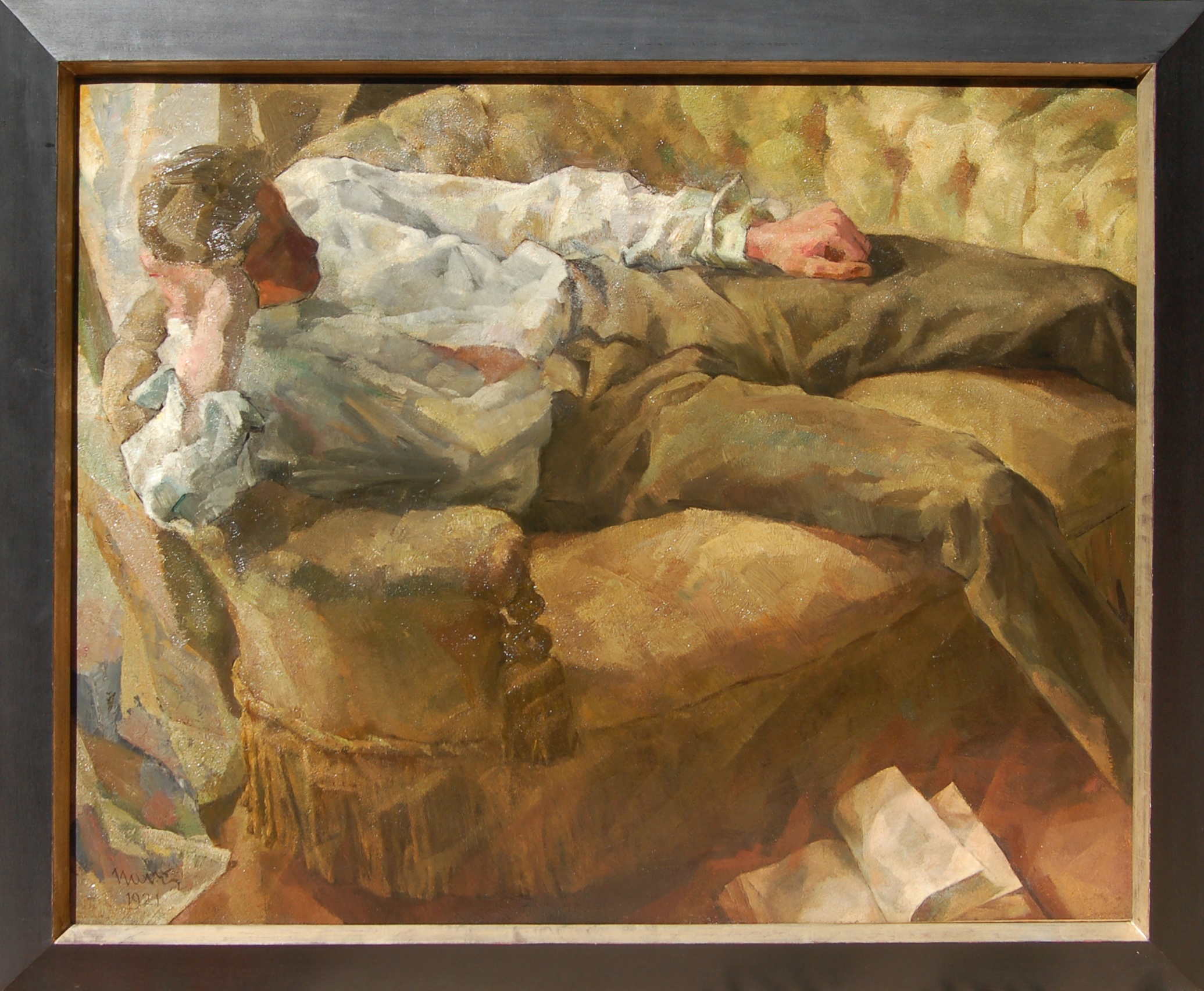
Relaxant
Oil on canvas
32 x 39 inches sight size – 36 x 43 inches framed
Signed and dated, 1921
Provenance: Private Collection, Brussels
Alan Barnes Fine Art, Dallas
The work was executed, signed, and dated 1921 by Arthur Navez. The lower-left corner bears his original signature and date, anchoring its origin to his active period working among the Brabant Fauvists in Belgium
Biography of Arthur Navez ( 1881–1931, Belgian )
Born in Antwerp on March 17, 1881, Navez quickly demonstrated an innate skill for drawing. He began his formal training at the Royal Academies of Fine Arts in both Antwerp and Brussels. Seeking to immerse himself in the epicenter of the avant-garde world, Navez relocated to Paris in 1900.
While in Paris, he studied under the highly traditional academic master Jean-Léon Gérôme at the École des Beaux-Arts. However, Navez found himself far more captivated by the city’s revolutionary modern movements. He heavily absorbed the works of Impressionist and Post-Impressionist masters—particularly Edgar Degas, Édouard Manet, and Paul Cézanne—whose unique framing, lighting, and textures permanently altered his artistic approach.
The Return to Belgium and Brabant Fauvism
Navez returned to Brussels at the end of 1907 and quickly aligned himself with progressive local art circles, showcasing his work with the collective Le Sillon in 1908. Alongside fellow visionaries like Rik Wouters, Ferdinand Schirren, and Jean Brusselmans, Navez became a key contributor to Brabant Fauvism.
Inspired by French Fauvists like Henri Matisse and André Derain, Navez and his contemporaries abandoned literal colors and rigid drawing. Instead, they emphasized bright palettes, heavy impasto, and spontaneous compositions. Despite the radical shifts in color, Navez kept a strong sense of structure in his work, often introducing clever visual framing elements like domestic window views, reflections, and mirrors. He applied this distinct style across an array of subjects, specializing in intimate interior scenes, landscapes, elegant portraits, and vibrant still lifes.
Theater, Film, and Later Years
In the 1920s, the Brabant Fauvists naturally drifted down separate creative paths. Navez expanded his talents beyond the canvas, adapting his color mastery into high-level design work for theater and cinema. Notably, he served as the artistic director for the 1922 French silent film Le Carillon de minuit (The Midnight Chime), collaborating with iconic early filmmakers like Jacques de Baroncelli and René Clair.
Navez continued to paint and design actively until his untimely death in Ixelles, near Brussels, on May 20, 1931, at just 50 years old. Today, his vibrant subversion of classical portraiture and daily life scenes serves as a essential precursor to the evolution of modern Belgian Expressionism.
View All Works