
A Friendly Encounter
Oil on canvas
12 x 16 inches sight 20 x 24 inches framed
Signed
Provenance:Private Collection, USA
Alan Barnes Fine Art, Dallas TX
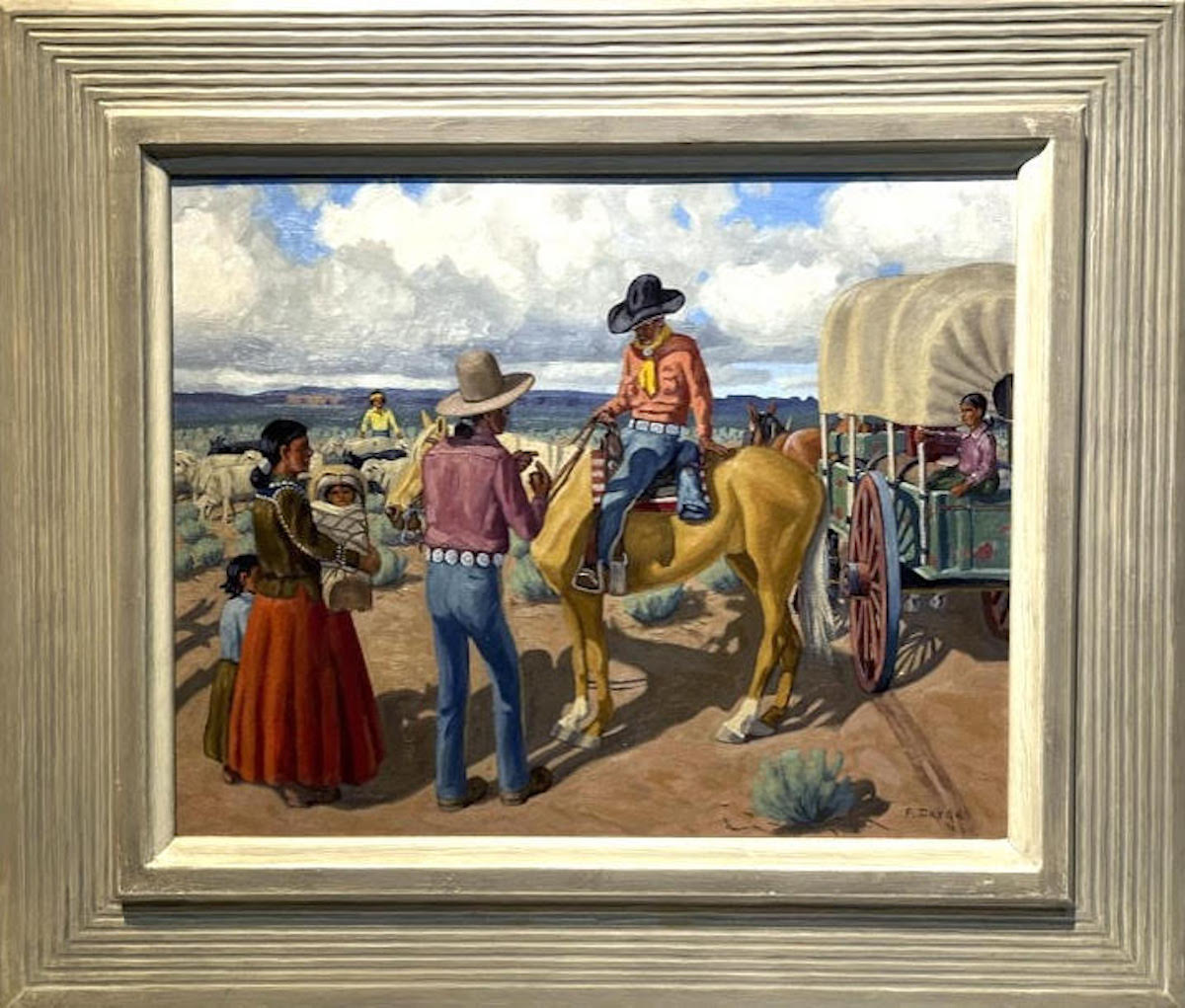
A Friendly Encounter
Oil on canvas
12 x 16 inches sight 20 x 24 inches framed
Signed
Provenance:Private Collection, USA
Alan Barnes Fine Art, Dallas TX
Fred Darge was a German immigrant who arrived in the United States via a merchant ship in Port Arthur, Texas, in 1923. He studied at the Art Institute of Chicago and worked as a commercial artist and draftsman before establishing himself in Texas, eventually living in Dallas for the remainder of his life. Drawn to the Western lifestyle, he launched his professional art career in the Big Bend region, where he paid for his stay on various ranches by creating paintings of the properties, often including depictions of the families and friends he met. His work serves as a historic painted record, capturing the Big Bend landscape and its ranching culture—with its cattle, sheep, and goats—before the land was purchased for state and national parks and its structures were dismantled.
His career gained momentum in the 1930s; his framed, miniature Big Bend paintings were sold at Neiman Marcus, and his work “Open Air Gospel” was selected for the 1936 Texas Centennial Exposition in Dallas. He continued his annual trips to the Big Bend ranches into the 1940s. Darge joined the U.S. Army in 1942, serving in the South Pacific during WWII. Honorably discharged in 1944, he used his drafting skills as a technical illustrator for the war effort and, as a result of his service, became a naturalized American citizen under the legal name Fred Ernest Darge. That same summer, he exhibited paintings of his service locations at the Dallas Museum of Art.
After the war, Darge embraced his wanderlust, retrofitting a WWII surplus ambulance into a mobile studio and camper. This vehicle allowed him to travel and paint on location throughout the American West. His work from this period included illustrations for a biography of explorer Zebulon Pike and paintings of daily life on the Navajo Nation, Native Americans in Taos, and the ornate Catholic churches of northern New Mexico. He was also drawn to the red sandstone formations of Sedona, Arizona, and traveled to Oklahoma’s Wichita Mountains Wildlife Refuge to paint bison, elk, and deer. Growing recognition of his art was bolstered by a solo exhibition at the Laguna Gloria Art Museum in Austin in 1948. By the 1960s, after more than three decades as a professional artist, he had produced countless canvases of Western themes and supplemented his income by teaching art. Darge passed away in the spring of 1978, having remained true to his vision of painting ordinary people and moments, which through his eyes became extraordinary.