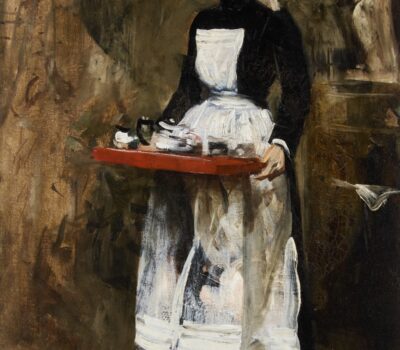
William Merritt Chase, a native Midwesterner born in Franklin, Indiana, became one of the most revered figures in American art, renowned as much for his painting as for his profound influence as a teacher, described as “the single most important teacher of his generation, perhaps in all of American art education.” Though he considered himself a realist, his work skillfully incorporated elements of Tonalism, Impressionism, and Realism, reflecting his progressive alignment with groups like the Society of American Artists and his willingness to evolve.
His early training included private lessons in Indianapolis and formal studies at the National Academy in New York, followed by a pivotal period from 1872 to 1878 at the Royal Academy in Munich. Sponsored by patrons who recognized his talent, he mastered the bravura style, distinguished himself with honors, and formed lasting friendships with artists Frank Duveneck and John Twachtman. Upon returning to New York, he taught at the Art Students League from 1878 to 1894 and established his legendary studio in the Tenth Street Studio Building. This lavishly decorated, treasure-filled space, modeled after European masters and featuring an eclectic collection of antiques, weapons, and art, was a carefully orchestrated marketing tool that attracted clients and served as an inspiration to his students and colleagues.
A dedicated proponent of painting outdoors, Chase believed, “I don’t believe in making pencil sketches and then painting your landscape in your studio. You must be right under the sky.” This philosophy was evident in his prolific plein-air work in locations like Brooklyn’s Prospect Park, New York’s Central Park, and most famously at the Shinnecock Summer School of Art on Long Island, which he ran for twelve seasons beginning in 1891. It was during this period that the influence of Velázquez, whom he deeply admired after a trip to Spain, and later Édouard Manet, led him toward a brighter, more Impressionistic palette and an increased use of pastels.
Chase’s career was also marked by extensive travel and teaching. He returned to Europe in 1881, spending time with Mary Cassatt and John Singer Sargent, and later conducted summer workshops on the West Coast in Carmel and San Francisco, where he served on the jury for the 1915 Panama-Pacific Exposition. Until his death in 1916, Chase remained a dynamic and dedicated force in the art world, once expressing a wish to live four times so he could continue pursuing the artistic passions that defined his remarkable life.