
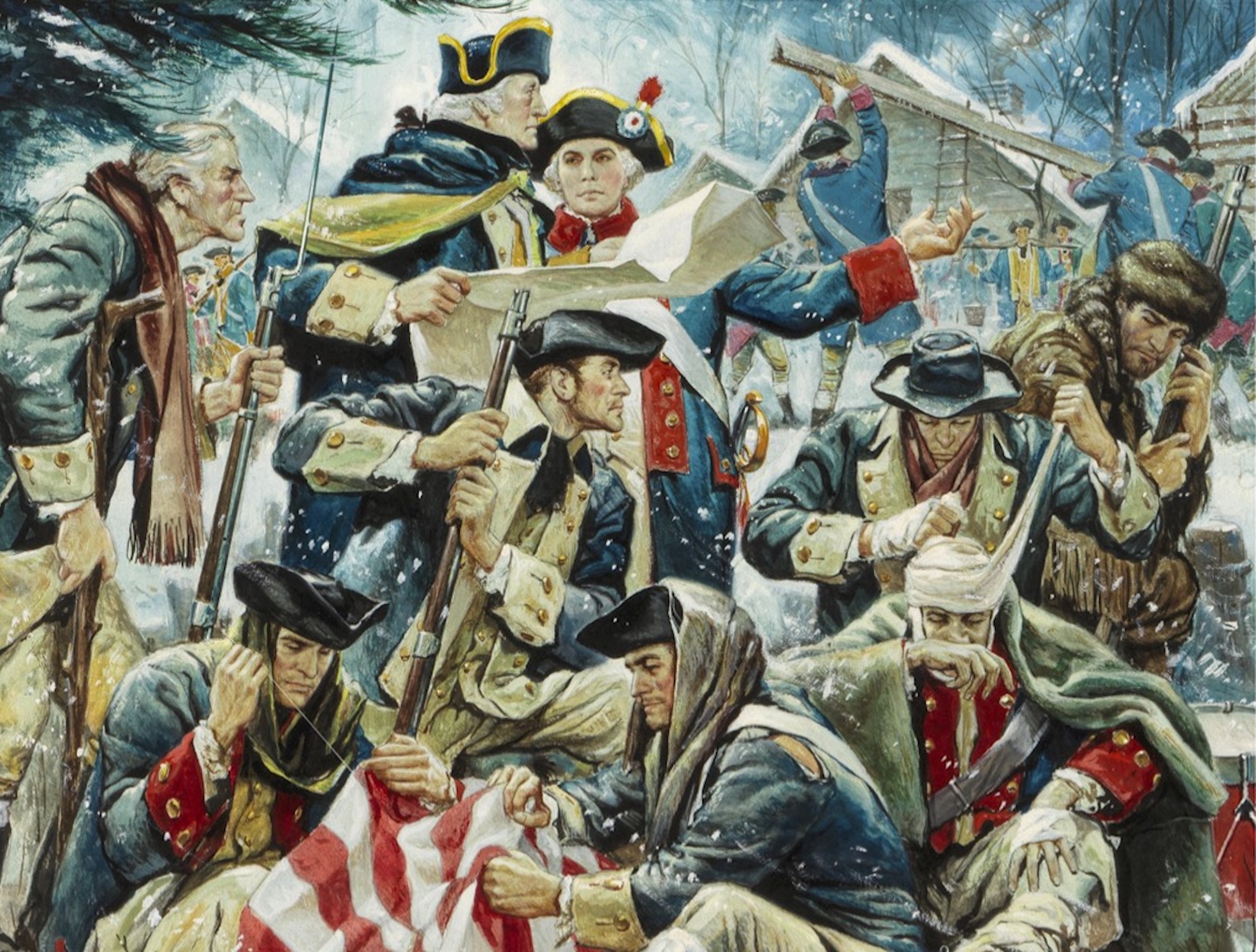
Winter at Valley Forge
Gouache on paper
18.25 x 19.75 inches
Signed, Lr. Reynold Brown
Provenance: The Weitzman Family Museum
Exhibitions: Yale Art Center
Winter at Valley Forge
Gouache on paper
18.25 x 19.75 inches
Signed, Lr. Reynold Brown
Provenance: The Weitzman Family Museum
Exhibitions: Yale Art Center
Reynold Brown (1917–1991) was an American illustrator and artist, born in Los Angeles and best known for his iconic movie poster art. His early passion for drawing, particularly narrative comic-style stories for neighborhood children, led to a well-rounded art education at Alhambra High School under artist Lester Bonar. Though he won a scholarship for art school, his father’s death forced him to work to support his mother and sisters. Around 1937, with Bonar’s help, he began inking and drawing the syndicated comic strip “Tailspin Tommy,” where he worked until 1941.
Influenced by illustrators like J.C. Leyendecker and Norman Rockwell—whom he met through Bonar—Brown transitioned into illustration. During World War II, he used his aircraft rendering skills to work at North American Aviation, creating technical and “phantom” drawings that revealed internal structures of aircraft. There he collaborated with Mary Louise Tejeda, whom he married in 1946. After the war, the couple moved to New York, where Brown illustrated for magazines like Boys’ Life and Popular Science and created paperback covers for authors like William Faulkner and Erle Stanley Gardner.
By 1951, due to family responsibilities, Brown returned to California and resumed freelance illustration. He also taught at Art Center College of Design for 26 years, mentoring notable artists like Robert Peak and Dru Struzan. Through art director Misha Kallis, Brown began a prolific career in movie poster art, creating over 250 campaigns for films such as Ben-Hur, Spartacus, The Time Machine, and Creature from the Black Lagoon. His work featured stars like John Wayne, Elizabeth Taylor, and James Stewart.
In the 1970s, Brown shifted to fine art, focusing on Western themes and selling approximately 250 paintings. After a severe stroke in 1976 left him partially paralyzed, he retrained himself and continued to produce drawings and landscapes until his death in 1991. His wife, Mary Louise Tejeda, also an artist, continues to paint.