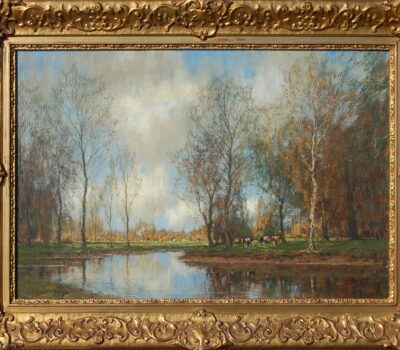
Arnold Marc Gorter was born in the rural farming area south of Almelo, the youngest of 11 children. His mother, Geertruida ten Cate Hoedemaker, found time to be a painter of flowers, mainly in watercolours who taught Arnold a love of Nature and Art. In 1884 Arnold chose to move to Amsterdam to attend art school at the Rijksmuseum. Graduating in 1887 he commenced painting the landscape of his native countryside particularly the woodlands by the Gein-river.
In 1896 he joined the secession-like artists society Sint Lucas and became vice-president soon. A little later he was elected president of this now rapidly growing art-club in which not only painters but also architects, musicians and actors, as well as art-lovers were united. It was at this time that he met Piet Mondrian among the new members.
The much older art society Arti et Amicitiae, of which Gorter in 1889 had became a member, gave young artists fewer facilities to exhibit and had higher entry-terms to match. In 1904 he exchanged his presidency of St Lucas for the vice-presidency of Arti, to become its president many times in later years.
In 1898 he had his first solo-show in Amsterdam at the Frank Buffa gallery. This art-dealer, represented well-known painters like J.H. Weissenbruch, Isaac Israëls and Jan Toorop.
By 1910 Gorter’s name was well known as one of the leading and most popular painters in Holland and abroad through his exhibitions in Germany and France. He received many gold medals and other rewards in Paris and Munich. The French State bought one of his paintings and later made him a member of the French Academy, an honour he shared with only a few other foreign painters.
English and American art dealers now became interested too. The first exhibition of his work in America was at the 1904 Universal Exhibition in St.Louis and later at the San Francisco Pan Pacific Exhibition of 1915.
The Queen of the Netherlands, Wilhelmina, took up painting round 1919 and wanted to invite a real landscapist as a tutor or as companion painter. Knowing Gorter from her yearly visits to the Arti-exhibitions and having bought one of his paintings already in 1913, she thought of him. In 1921 Gorter was invited to her countryside palace at Apeldoorn to paint the autumn colours together. The next year an invitation followed to accompany Wilhelmina and members of the court on a two-month cruise along Norway’s coast, to go painting there.