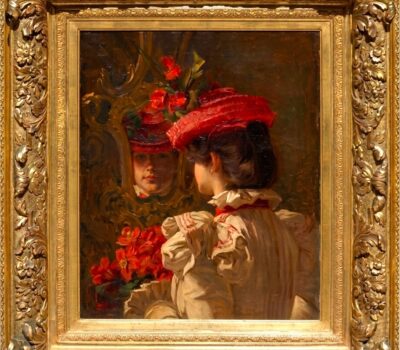
Gustave Vanaise was a prominent Belgian painter born on October 4, 1854, in Ghent, who became widely celebrated for his masterfully executed history pieces, large-scale biblical scenes, and intimate portraits. He began his artistic training at the Royal Academy of Fine Arts in Ghent under the guidance of Théodore Canneel before completing his studies in Brussels. In 1878, Vanaise moved to Paris, where he regularly exhibited large history paintings at the Paris Salon, developing a style characterized by a warm, rich palette heavily influenced by traditional Flemish and Dutch masters.
His reputation as a central figure in late 19th-century art was solidified when he became a founding member of the influential Belgian avant-garde group Les Vingt (Les XX) in 1883. Throughout his career, he bridged the gap between academic realism and Symbolist depth, using dramatic light and psychological tension in famous works like Saint Livinus in Flanders (1882) and Salomé (1895). In his later years, Vanaise focused heavily on painting portraits of the Ghent and Brussels bourgeoisie, frequently casting his wife, Marie De Coster, as his model. He continued working until his death in Saint-Gilles on July 2, 1902, leaving behind a rich legacy with many of his major pieces preserved today at the Museum of Fine Arts, Ghent.