
Under the Arbor
Oil on canvas
29 x 24 inches
Signed, lower right
SOLD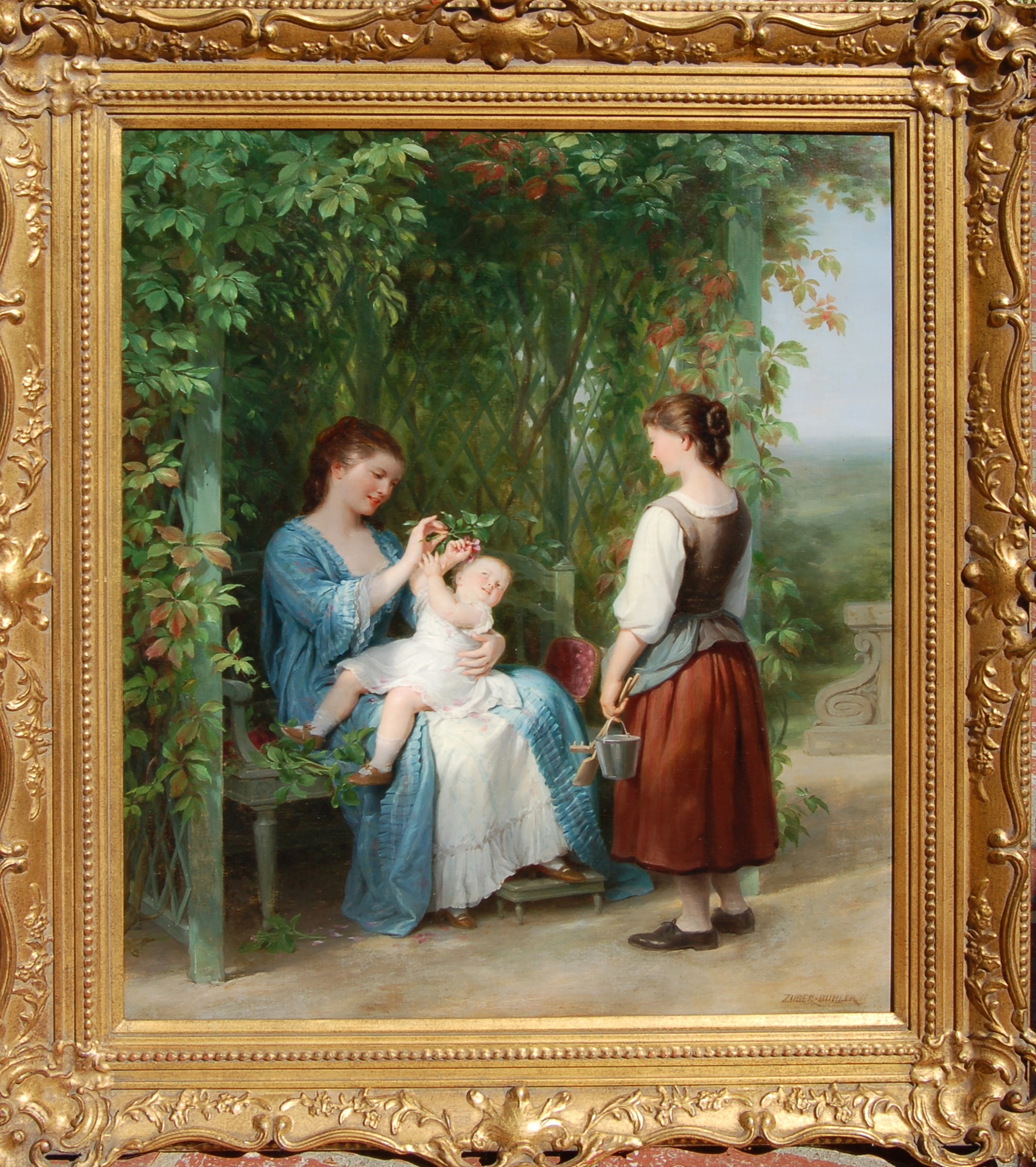
Under the Arbor
Oil on canvas
29 x 24 inches
Signed, lower right
SOLDZuber-Bühler was born in 1822 in Le Locle, Switzerland, but moved to Paris at the age of sixteen to begin his studies under Louis Grosclaude—even before officially enrolling at the École des Beaux-Arts and joining the studio of François-Édouard Picot. It was Picot who established an entire artistic dynasty of painters trained in the academic style and traditions, for he himself was an academic artist who had originally studied under Jacques-Louis David. Serving as a mentor not only to Zuber-Bühler but also to contemporaries such as Bouguereau, Alexandre Cabanel, Léon Perrault, and many others, Picot continued to cultivate the principles of the academic tradition, passing them on to his numerous students—who, in turn, also became artists of the academic school.
In addition to their foundational yet rigorous training at the Parisian school, many students continued to undertake a sort of “pilgrimage” to Italy—a country that remained a source of inspiration for many artists, whether for the opportunity to view the canvases of the Old Masters or to master the sublime genre of landscape painting.
According to some accounts, Zuber-Bühler also left Paris to travel and study in Italy—presumably at the age of nineteen. He spent five years abroad. However, there are also claims that, between 1843 and 1844, he was a student at the Berlin Academy. It is entirely possible that Zuber-Bühler spent some time in Italy before continuing his studies in Germany, thereby enriching his artistic practice with experiences gained both within the studio walls and beyond them.
Having concluded his travels and studies in Paris, Italy, and—possibly—Berlin, Zuber-Bühler returned to Paris to begin building his career as an artist. He began exhibiting at the annual Salon, making his debut in 1850 with the works *The Childhood of Bacchus* (*L’Enfance de Bacchus*), *Madonna and Child* (*La Madone et l’Enfant Jesus*), *Portrait of Madame the Marquise de F…* (*Portrait de Mme la marquise de F…*), and the painting *Dust Returns to Dust, and the Spirit Ascends to God Who Gave It* (*La Poussière Retourne à la Poussière et l’Esprit Remonte à Dieu Qui l’a Donné*). Throughout his career, he continued to participate actively in exhibitions, often submitting several works to the Salon simultaneously. His artistic output also included drawings, pastels, and watercolors, which he submitted to the Salons alongside his oil paintings. In 1867, he also exhibited in the United States—at the Pennsylvania Academy of the Fine Arts—where he displayed the work *The Beloved Kitten*; furthermore, he participated in the 1877 exhibition, for which he received an award.
It is evident that the style Zuber-Bühler presented at the Salon was well received by both the jury and the public—a fact attested to by the sheer number of paintings he submitted to his debut exhibition in 1850 alone. His works also demonstrate Zuber-Bühler’s commitment to thematic diversity, though he invariably focused on subjects capable of transcending cultural boundaries and finding a universal resonance with the viewer. He approached works on mythological and religious themes with great interest, and also accepted commissions for portraits. Both mythological and religious subjects occupied the highest tier in the hierarchy of the annual Salons and inspired profound admiration among the public. Zuber-Bühler continued to exhibit at the Salon until 1891.
He passed away on November 23, 1896, in Paris. Throughout his artistic career, Zuber-Bühler championed the principles of the academic style, demonstrating that his art was grounded in the professional training he had received at the École des Beaux-Arts. He became part of a long-standing and firmly established academic tradition—one that, by the twilight of his career, had entered a period of decline. This decline was not a matter of waning popularity among patrons, but rather a consequence of the opposition posed by modernists, who had begun to challenge this academic aesthetic. Notwithstanding the rivalry between these competing artistic factions, Zuber-Bühler’s art undoubtedly enjoyed popularity among the public during both the Second Empire and the Third Republic in France, resonating with the atmosphere of growing prosperity characteristic of those eras.
Today, his works are held in museums in Bern, Le Locle, and Neuchâtel (Switzerland), as well as in Montpellier (France).