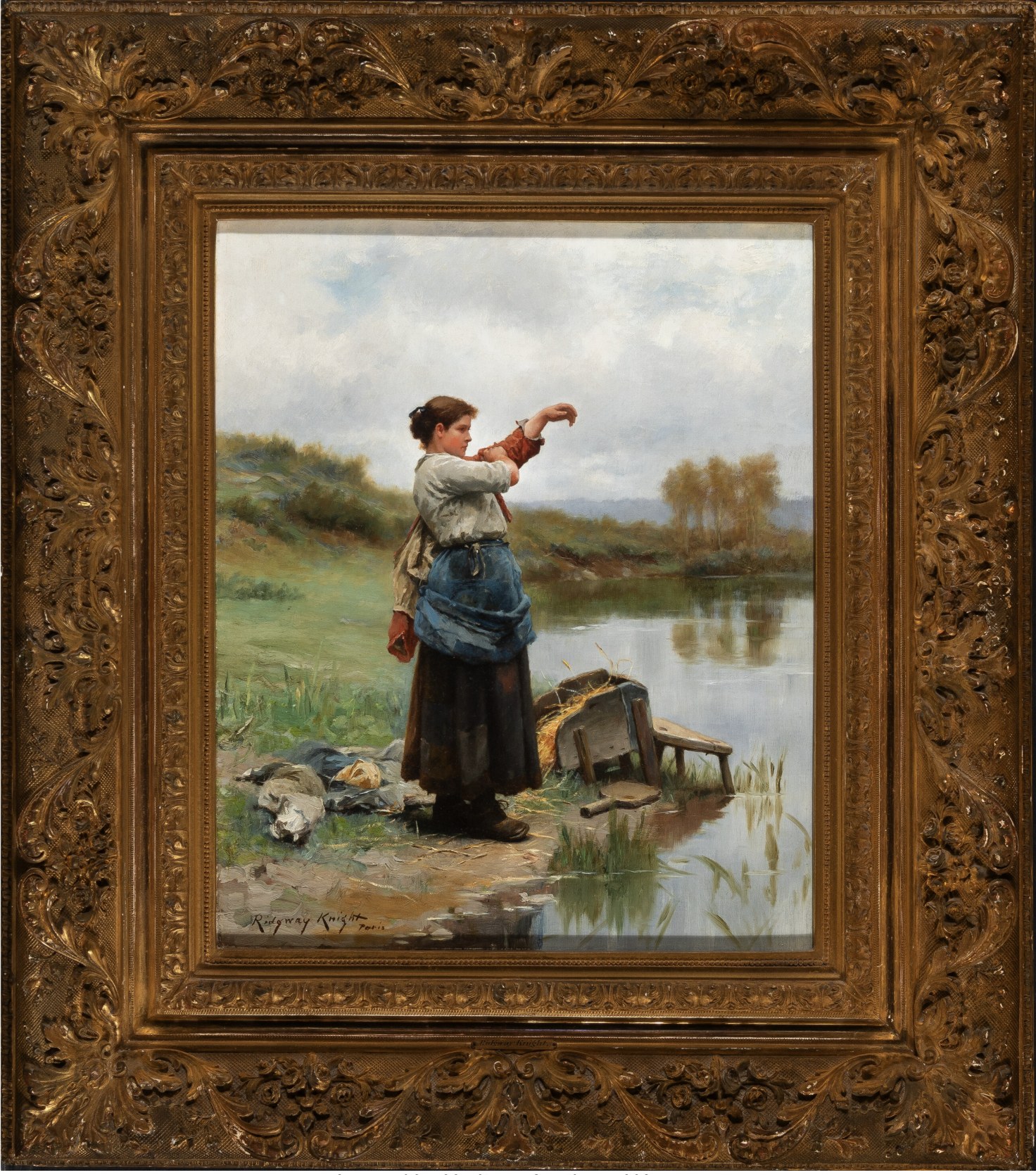
Jeune Fille Mettant Caraco, o Lavandière, 1889
Oil on canvas
22 x 18-1/4 inches (55.9 x 46.4 cm)
Signed and inscribed lower left: Ridgway Knight / Paris
PROVENANCE:
The artist;
Boussod, Valadon, et Cie., Paris, acquired from the above, 1889 (as Jeune fille mettant caraco);
William Buchanan, New York, acquired from the above, 1889;
His sale: American Art Galleries, New York, April 18, 1912, lot 72 (as The laundress at Passy);
C. J. McDonough, acquired from the above;
John J. Harrington (trustee);
Knoedler & Co., New York, consigned from the above as, Girl Washing, 1925;
Lawrence C. Phipps (1862-1958), Washington, DC, acquired from the above, 1926;
Miss Ailsa Mellon (1901-1969), Washington, DC, acquired from the above;
J. J. Gillespie Fine Art Galleries, Pittsburgh;
William Henry Remmel (1872-1951), New York, 1934;
Mr. & Mrs. Norman E. Sharp, New York, by descent from the above;
Skinner, Boston, September 27, 1996, lot 493 (as Lavandière);
Spanierman Gallery, New York, acquired from the above;
Rene Foufouy Fine Arts, New York;
Cathy Nullmeyer, Toronto, 1998;
Waddington’s, Toronto, November 28, 2019, lot 303 (as Jeune fille mettant caraco);
Acquired from the above by the present owner.
This work is included in the Rehs Galleries, Inc., Daniel Ridgway Knight online catalogue raisonné (SF1068)
Biography of Daniel Ridgway Knight ( 1839-1924, American )
Daniel Ridgway Knight (1839-1924) was a prominent American expatriate artist working in 19th century France. He was born in Pennsylvania and attended the Pennsylvania Academy of Fine Arts along with Mary Cassatt and Thomas Eakins. In 1861, Knight went to Paris for two years to study at the Ecole des Beaux-Arts. He apprenticed under Charles-Gabriel Gleyere (1806-1874) and worked briefly under
Jean-Louis-Ernest Meissonier (1815-1891).
In 1863 Knight returned to Philadelphia to serve in the Union Army. He founded the Pennsylvania Sketch Club where he exhibited portraits and battle scenes sketched during the war. He married in 1871, and in 1872 Knight and his new wife moved to France and settled in Poissy, a village just north of Paris.
Knight’s work exhibits the influences of his French Impressionist friends Pierre-Auguste Renoir and Alfred Sisley, also pupils in Gleyere’s atelier. The influences of other contemporaries including Jean-Francois Millet, Jules Bastien-Lepage and Jules Breton can also be identified. In contrast to these proponents of realism, Knight’s work depicts the “peasant-picturesque.” Young, pretty maidens stroll through scenic landscapes and bountiful gardens, there is nothing to indicate the economic hardships of the peasant class. Knight often used local peasant women as models, dressing them up costume and placing them in idyllic settings. In Summer Afternoon, Seine Valley the maiden stands in a picking garden in full summer bloom. Knight showcases his skills as a flower painter. Here in a field of poppies, lupine, sunflowers and dahlias the young maiden selects the best bloom to pick. The artist successfully captures the tender way in which the maiden holds the flower and her gaze as she admires it.
Universally appealing, Knight’s works are widely collected by museums and individuals alike. During his lifetime Knight earned a multitude of ribbons and prizes, exhibiting in both Europe and America. The Pennsylvania Academy of Fine Arts, the Milwaukee Museum and the Brooklyn Museum were
among the first public institutions to collect his work.
View All Works