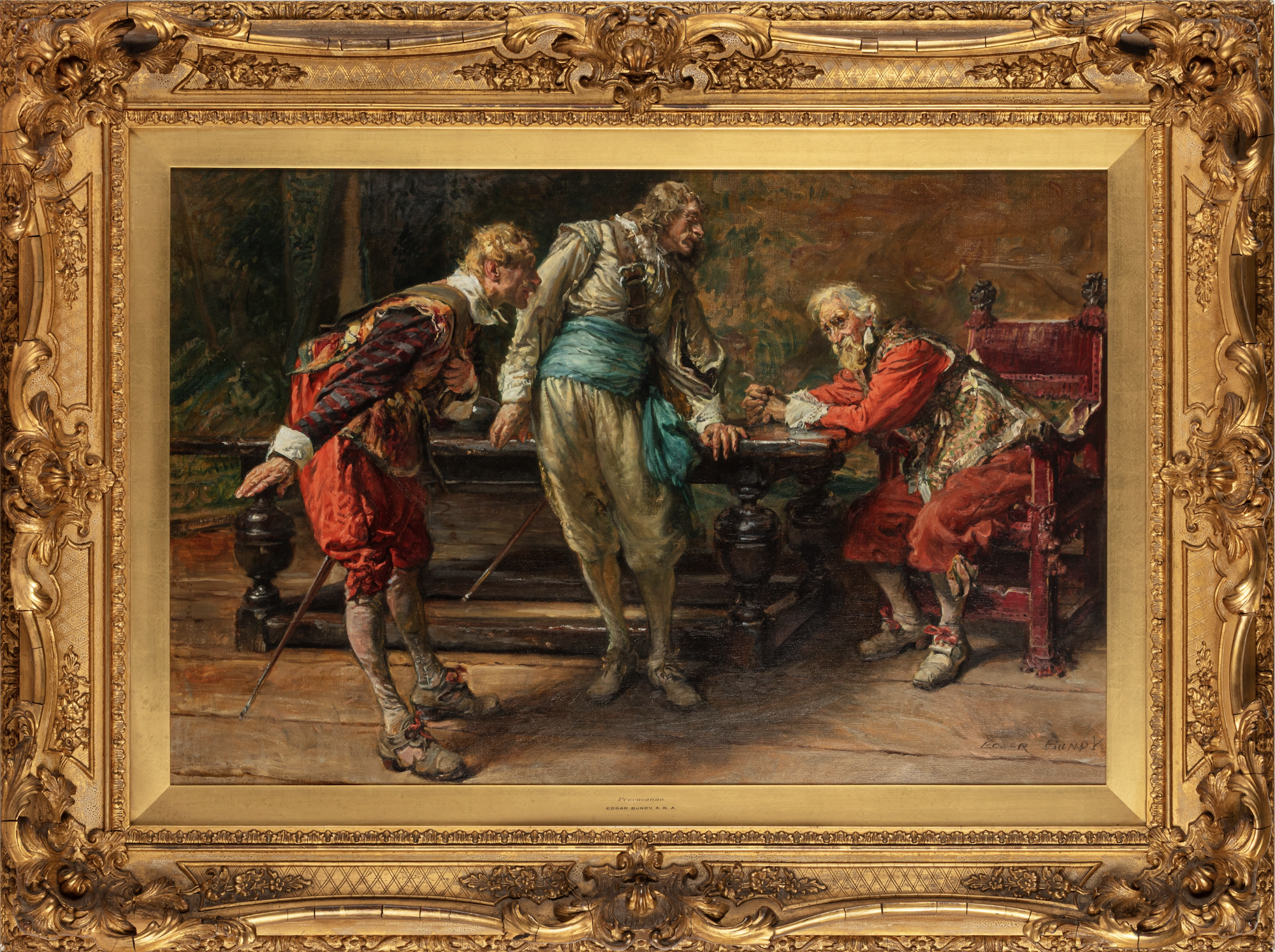
Biography of Edgar Bundy ( 1862-1922, British )
Edgar Bundy (1862–1922) was a self-taught English painter celebrated for his richly detailed historical and narrative scenes. Born in Brighton on March 29, 1862, Bundy received no formal academic art training, instead picking up the foundational skills of his craft as a youth while spending time in the studio of the Victorian artist and sculptor Alfred Stevens. Despite his unconventional start, his natural talent for lively brushwork, theatrical compositions, and vibrant color palettes quickly drew attention. He began exhibiting at the Royal Academy at just nineteen years old in 1881 and went on to establish a prolific career in London. Strongly influenced by the Pre-Raphaelite movement and the writings of John Ruskin, Bundy specialized in both oil and watercolor paintings that brought historical events and literary scenes—such as works by Charles Dickens—to life for late Victorian and Edwardian audiences nostalgic for an idealized past.
Over the course of his career, Bundy earned widespread institutional acclaim and international recognition. In 1891, he was elected a member of both the Royal Institute of Oil Painters (ROI) and the Royal Institute of Painters in Water Colours (RI), and he also held membership in the Royal Society of British Artists (RBA). His reputation was cemented in 1905 when his dramatic English Civil War painting, The Morning of Sedgemoor, was purchased by the Chantrey Bequest for the Tate Gallery in London. Bundy later exhibited at the Paris Salon beginning in 1907, was elected an Associate of the Royal Academy (ARA) in 1915, and painted major historical commissions, including a 1918 canvas depicting the landing of the First Canadian Division in France during World War I. He lived and worked in London—residing in Hampstead with his common-law wife, Elizabeth, and their children—until his death in St John’s Wood on January 10, 1922, at the age of fifty-nine.
Influences in Bundy’s work include Pre-Raphaelites such as John Millais, William Morris and the works of John Ruskin.
His daughter Dorothy married the painter Richard Barrett Talbot Kelly in 1924.
View All Works